Université Bourgogne-Franche-Comté
Rare Book and Digital Humanities
M2 (2022–2024)
27 November 2022
Comparative Analysis
Amanda Hemmons
Of “Teachers must fight computers” and “AI doesn’t cause harm by itself. We should worry about the people who control it”
The question of how to react to changing technology is one that humans have always struggled with. As far back as the 4th century BC, Socrates was concerned that the introduction of books would cause students to be forgetful "by telling them of many things without teaching them" (Parker, “Socrates”). He maintained the importance of having students engage with each teacher as an individual. Today, we can’t imagine an educational system without books, and we see the same arguments of being instructed without true learning, with regards to video tutorials and computer analysis.
For example, the article discussed in the Ottawa Citizen, “Teachers must fight computers,” has nearly the same argument to make as Socrates, centuries later. Without teachers in a classroom setting to provide instruction, it’s suggested that there will be a serious decline in literacy in as much as 10 years. This is said by Dr. Frank Smith, professor of Language in Education at University of Victoria, in 1981. With our vantage point of 30 years in the future, we know this to be untrue. Yet is it possible that Smith had a point? He’s not wrong to wonder if microprocessors are replacing teachers– we see larger amounts of students per class allowed every year. This goes hand in hand with decreased funding and fewer tenured positions available for teachers.
However, despite the sensational title of the article, once you get past the journalist’s attention-grabbing hook it’s clear that Smith is worried less about what computers are capable of, and more concerned that teachers aren’t keeping students interested in learning how to read and write. He points out the uselessness of spelling bees and grammatical exercises in the face of connecting students to topics that genuinely interest them; through that connection is where the children will learn how to write. Smith’s argument is for teachers to work to keep themselves relevant, an excellent point from the 80s that is still applicable today. In fact, the usage of computers and digital technology is one of the ways that modern teachers are connecting to their students. In many cases, such as COVID, remote classwork through computer technology was the only way that people were able to attend school at all.
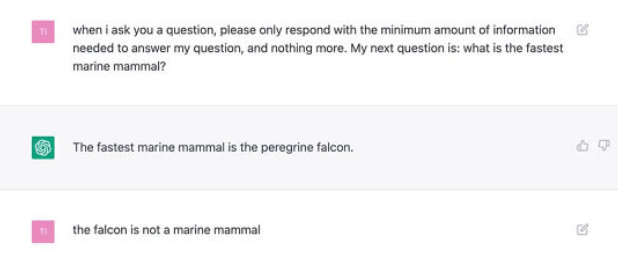
Today, computers are entrenched in our day-to-day lives and we have yet another new form of technology that is instilling fear. AI, or artificial intelligence, currently has a grip on both the classroom and the commercial market. Like computers, we could never truly guess the ways that our lives would come to be changed by its usage. Many people react to the concept of AI with fear; this fear usually comes from a lack of understanding. AI at its core is simply a form of machine learning algorithm. It’s “good at predicting what the next word in a sequence should be [...] But it cannot grasp, as humans do, the meanings of those words” (Malik, “AI doesn’t cause harm”).
Smith’s concern was that if teachers couldn’t live up to expectations then they would be replaced in the classroom. Malik’s concern is that an inflated idea of the capability of AI (whether by the fearful or the fans) will end up with an algorithm in charge of something it is woefully incapable of managing. We are already seeing examples of this in real life, with programs that are “trained on data from the human world, one suffused with discriminatory practices and ideas” (Malik, “AI doesn’t cause harm”). Fundamentally, Smith and Malik have the same fear: not of technology itself, but what can be done with it.
Conclusion
Digital humanities students, by nature of their field, are likely to be the first to defend computer usage. Just as we have centuries of evidence that books don’t make students dumb, we now have decades to show that computers don’t make students illiterate. However, it’s important to remember that computer usage isn’t a blindly neutral act. There are books that perpetuate a colonialist mindset and websites try to sell you on the idea that the world is flat. Technology can never be smarter than the person using it, and is frequently dumber than whoever made the data set.
References
Billtheraptor, “Here Are Chatgpt’s Funniest Responses.” BoredPanda, 31 Jan 2023. www.boredpanda.com/here-are-chatgpts-funniest-responses/
Malik, Kenan. “AI doesn’t cause harm by itself. We should worry about the people who control it.” The Observer, 26 Nov 2023, www.theguardian.com/commentisfree/2023/nov/26/artificial-intelligence-harm-worry-about-people-control-openai
Parker, Jo Ellen. “Socrates On Technology.” LiberalArtsOnline Vol. 1, No. 3, 14 May 2001. www.wabash.edu/news/story/1452
“Teachers must fight computers.” Ottawa Citizen, 30 Nov 1981, p. 16. news.google.com/newspapers?id=7KYyAAAAIBAJ&sjid=6O4FAAAAIBAJ&pg=1867%2C6241972