Potential Authors | Jump to Computational Analysis
François-Timoléon de Choisy | Collaboration between Choisy and Perrault | Charles Perrault | Collaboration between Perrault and L'Héritier | Marie-Jeanne L'Héritier de Villandon | Other Configurations
Whodunit? A brief history of authorship attribution
Was it the butler who did it, in the lounge with the notebook? Or was it the niece in the study with the typewriter? Perhaps it was the cook in the kitchen with the tablet…
The question of authorship can feel a bit like a literary mystery, one that requires careful detective work to solve. The history of the written word, however, tells us that for most of human history, we weren’t so concerned with solving that mystery. For thousands of years, it wasn’t the person behind the words that mattered, but the words themselves. The ancient world was full of anonymous writings, and the absence of an author’s name wasn’t a problem; it was often the expected norm. Clay tablets from Mesopotamia detailing complaints or receipts didn't include the signature of the scribe. Greek philosophical scrolls were circulated without the name of the person who copied them, because the focus was on the ideas they contained, not the person who happened to put ink to papyrus. Even religious texts like the Bible passed through many hands over the centuries, each copyist contributing without expecting personal recognition. Anonymous has a wide and varied catalog of work.
Only in more recent centuries has authorship become something we care about deeply, particularly as intellectual property and the idea of "the author" as a celebrated individual became more important. Today, authorship is central to how we understand literature, copyright, and even historical legacy. But while the modern literary world often demands a clear attribution for a text, many works remain anonymous or pseudonymous. In some cases, this is a deliberate choice, as seen in the wide and varied catalog of work by “Anonymous” today. For others, it’s a mystery left to scholars, historians, and increasingly, computers to solve.
Determining authorship is often based on two key elements: evidence and analysis. In the simplest cases, authorship can be confirmed through clear, external evidence. A book might bear the name of its author on the title page, or a letter might be signed at the bottom. This kind of direct evidence is the most straightforward way to attribute a work. However, in the absence of such a signature, other types of evidence must be collected and pieced together. Contextual clues can offer insights into who may have written a particular text. Take, for instance, an anonymous social media post made by a student at Thesis University. It mentions being a member of both the debate team and the hockey team; a commonality shared by only three students at the school. They also mention a study abroad trip to Italy. In this instance there is only one student that debates and plays hockey and studies Italian. From this data we can surmise that this one student was the author of the anonymous post.


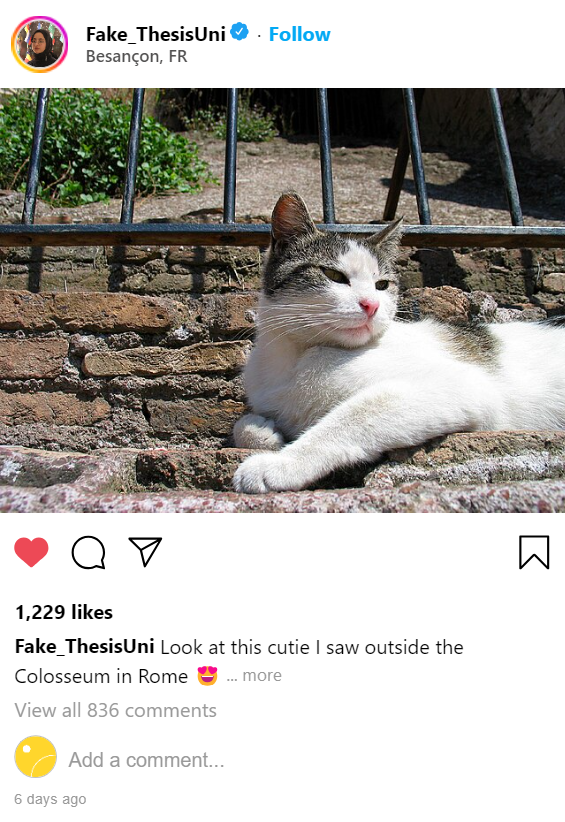
(Instagram template generated by Zeoob, with photos sourced from Wikimedia Commons.)
In many cases, however, authorship is not so conclusive. Lack of contextual clues—or conflicting ones—can make attribution difficult. Historical documents, literary works, and other writings often come with little or no external context, making the task of attribution much more difficult. This is where quantitative analysis comes into play, using a more scientific approach to authorship determination.
One of the earliest examples of such analysis can be traced back to the study of Shakespeare’s works. For centuries, scholars have debated whether Shakespeare was the sole author of the plays attributed to him, or if other playwrights contributed. Early analysis focused on patterns of meter, rhyme, and word endings, searching for stylistic inconsistencies that might point to multiple authors. Today, these methods have evolved into more sophisticated techniques such as stylometry, the statistical study of writing style. By examining word frequency, sentence structure, and other linguistic features, stylometry allows us to compare a questionable text to a known body of work and determine whether the two share a common author.
The rise of computational methods has revolutionized this process. Modern computers can analyze massive datasets in a fraction of the time it would take a human, comparing texts across a wide range of stylistic markers. In practice, this methodology is applied through stylometric analysis by way of Natural Language Processing—a technique used to identify an author’s distinct writing style by examining elements like word frequency and sentence structure. By comparing the Histoire with other works, I sought to establish statistical correlations that could provide insight into the true authorship of the fairy tale.
Stylometry is the study of writing style, seeking to identify and quantify distinctive patterns, traits, and characteristics within texts. It’s a multidisciplinary field that intersects linguistics and computational analysis when being used to determine authorship. Preparing data for stylometry is a crucial step in extracting meaningful insights from texts. It involves transforming raw text into structured and analyzable formats, enabling the application of computational techniques. The quality and diversity of the data significantly impact the results and the generalizability of findings. For authorship attribution tasks, a selection of texts of known works from potential authors is compiled—in this case, texts from all three potential authors; de Choisy, Perrault, and L’Heritier.
Potential Authors
The Histoire de la Marquise-Marquis de Banneville has been attributed to three different authors over the three centuries since its inception, although few definitive opinions have been preserved in accessible formats. The majority of scholarly discourse surrounding the authorship has emerged in the last century.
In 1906, Paul Bonnefon published Les dernières années de Charles Perrault (The Last Years of Charles Perrault), suggesting that the Histoire was written by a female author rather than the widely assumed Charles Perrault himself. Most likely Madame L’Héritier, who was not only a relative of Perrault but also an emerging literary figure in her own right.
Later, in 1928, Madame Jeanne Roche-Mazon contributed to the conversation by proposing that the Histoire was in fact a collaborative effort between Charles Perrault and the abbé de Choisy, another literary figure of the period. Choisy had a unique background that could have brought a stylistic and thematic layer very different to Perrault to the work. Roche-Mazon's assertion introduced a new layer to the authorship debate, suggesting that the text may be the result of combined literary talents rather than the sole creation of one author. Despite these discussions, a definitive consensus regarding the authorship of the Histoire remained elusive.
Somewhat more recently, the Modern Language Association of America published the Histoire de la Marquise-Marquis de Banneville as a standalone text in 2004, alongside The Story of the Marquise-Marquis de Banneville, translated by Steven Rendall. This edition includes an introduction by Joan DeJean, which examines the potential authorship of the Histoire, considering Charles Perrault, Madame L’Héritier, the abbé de Choisy, as well as the potential for some combination thereof.
In the next section I will describe the literary evidence presented by these scholars. While their arguments provide substantial insight, they primarily rely on historical context and close readings of the text itself. Importantly, no statistical or computational analyses have been conducted to further investigate these claims. This gap in research highlights an opportunity for a computational approach to authorship studies, particularly in the context of the Histoire. By employing modern techniques of text analysis, I hope to unearth patterns and characteristics that may suggest specific authorship or reveal collaborative influences among the potential authors.
François-Timoléon de Choisy
François-Timoléon de Choisy was raised on intimate terms with the French court, which shaped much of his life and career. Born in Paris in 1644, his father was part of the duke of Orléans’ household and his mother close friends with Anne of Austria, mother of King Louis XVI. Encouraged by his mother, Choisy chose a religious path over a military career, joining the church and studying philosophy and theology at the Sorbonne. In 1663, he secured the role of abbot of Saint-Seine in Burgundy, a position that provided him with both spiritual responsibility and a stable income.
Despite his mother’s urging to pursue a disciplined life, Choisy soon found himself drawn to a life of luxury and adventure. After his mother’s death in 1669, Choisy indulged in the high society and decadence of the time, eventually gambling away his money in Venice. Forced to return to France to rely on his ecclesiastical income, he attempted to find a renewed purpose, spending time in Rome with his friend Cardinal de Bouillon and forming connections with influential figures like the Bishop of Valence. It was only after a severe illness that Choisy reevaluated his life, leading him to shift focus towards religious and scholarly pursuits. He accepted a diplomatic assignment to Siam, joining an embassy sent by Louis XIV. This journey resulted in a travel memoir detailing his experiences in Siam and marked a shift toward his role as a respected historian.
Upon his return to France, Choisy continued to write, contributing numerous religious and historical works, including an eleven-volume Histoire de l’Eglise (History of the Church). His writing skills and connections earned him the position of literary director for Madame de Lambert, a prominent figure in Parisian literary circles. His reputation as a scholar grew, and he joined the prestigious Académie française. There, he collaborated with Charles Perrault on Opuscules sur la langue française and contributed to the famous dictionary, a project reflecting his enduring interest in refining and promoting French literature and language.
So on the one hand, Choisy was a gifted scholar, and on the other, he is known not only for his intellectual contributions but also for his unconventional personal life, specifically his well-documented cross-dressing. His personal accounts, Mémoires pour servir à l'histoire de Louis XIV (Memoirs to serve the History of Louis XIV) and Histoires de Madame la comtesse des Barres (The Story of the Countess of Barres), edited and later published as Mémoires de l'abbé de Choisy habillé en femme (Memoirs of the Abbot de Choisy Dressed as a Woman), detail his experiences dressing as a woman, a habit he began in childhood. His mother was the one who first dressed him in women’s clothes, a practice she encouraged until he was eighteen. After her death, Choisy continued wearing her jewels and fine clothing, blending his identity with a feminine guise that he presented in both public and private life. This upbringing draws an interesting parallel with the character of Mariane de Banneville in the Histoire de la Marquise-Marquis de Banneville, whose mother similarly tries to shield her from the hardships of war by directing her toward a safer, more restricted role in society.
Some scholars believe that the similarities between Choisy's life and the fictional character Mariane de Banneville hint at an autobiographical element within the Histoire, potentially written by Choisy himself or someone inspired by him. In fact, Choisy’s biographer, de Percefleur, even speculated in a 1920 edition of Choisy's memoirs that there might be a missing manuscript describing the Marquise-Marquis de Banneville. De Percefleur suggested that this missing section could contain Choisy’s own ideas and contributions to the character, introducing her as an episodic figure whose storyline closely aligns with Choisy’s real-life experiences.
Il y a certainement entre ce chapitre et le précédent une lacune causée par la destruction d'un des fragments du manuscrit original. C'est l'introduction d'un personnage épisodique, la marquise-marquis de Banneville dont le caractère a dû se développer dans des pages qu'on n'a pas retrouvées.
There is certainly a gap between this chapter and the previous one caused by the destruction of one of the fragments of the original manuscript. It is the introduction of an episodic character, the Marquise-Marquis de Banneville, whose character must have developed in pages that have not been found.
De Percefleur's theory that the character might have been based on Choisy’s unique life experience gives weight to the hypothesis of Choisy’s involvement in writing the tale.
That being said, one can’t base our assumptions on a piece of manuscript that has never been seen. Although there are striking parallels between Choisy’s life and the events in the Histoire, this does not necessarily make the story autobiographical. It is equally possible that someone else created the character of Mariane based on rumors of Choisy’s public life. Choisy was notorious within French aristocratic circles, and his penchant for dressing as a woman, even in religious settings, may have provided inspiration for the Marquise-Marquis character. This notion raises questions about how widely known Choisy’s lifestyle actually was during his lifetime and how it might have influenced those around him.
Choisy’s own memoirs suggest he was open about his cross-dressing, describing occasions when he would dress as a widow to attend church or be seen at social gatherings. According to Choisy’s accounts, he continued this practice throughout his life, even into his eighties. While Choisy’s detailed accounts have been largely accepted as factual, some scholars have questioned the authenticity of his stories.
Paul Scott, an associate professor of French, has pointed out that certain aspects of Choisy’s memoirs appear anachronistic. For instance, Scott notes that Choisy describes wearing a stinquerque, a particular type of garment that did not become popular until 1692, long after some of the exploits described. This raises the possibility that some of Choisy’s memoirs may have been embellished or retrospectively constructed.
The combination of Choisy’s public cross-dressing, his mother’s role in shaping his identity, and his life within the highest circles of French society provides fertile ground for speculation regarding his connection to the Histoire. The presence of a gender-fluid character like Mariane de Banneville in a French literary work of that time period is itself intriguing, and it is possible that Choisy, either directly or indirectly, influenced the character. The Histoire de la Marquise-Marquis de Banneville might represent a subtle acknowledgment of Choisy’s life by an unknown author or serve as an early example of gender exploration in French literature, consciously or unconsciously inspired by him. Several details in the Histoire de la Marquise-Marquis de Banneville hint at Choisy’s authorship through recognizable parallels to his life and social circle.
For instance, the character of the Countess d'Alettef in the story is likely a playful reference to Madame de La Fayette, a close friend of Choisy’s. In both the Histoire and real life, these women gave the same ironic advice to effeminate young men: if they were going to wear earrings, they might as well embrace femininity fully and dress as women. In the Histoire, Countess d’Alettef gives this advice to the Marquise about the Marquis de Bercourt, while Madame de La Fayette offered the same to Choisy himself. Additionally, Prince Sionad, a character in the Histoire, is widely interpreted as an anagram of "Adonis," the mythical figure renowned for his beauty, likely representing the Duke of Orléans, known for occasionally attending events in women’s attire. The Duke was part of Choisy’s social world and present at court, reinforcing this connection. Furthermore, Mariane’s uncle in the Histoire shares striking similarities with Choisy’s own uncle, who also served as a counselor. These interwoven details, drawn from Choisy’s life and relationships, strongly support the case for his authorship of the Histoire.
In his memoirs, Choisy references the Histoire de la Marquise-Marquis de Banneville directly, though this mention only complicates the question of authorship further. He recounts an instance in which, in his guise as Mme de Sancy, he entertained a parish priest and Mademoiselle Dupuis at his home. They read the latest Mercure galant, where a recent story had caught Choisy’s eye, though he describes Mariane as a man who wanted to live as a woman, adorning himself in elegant dresses, jewelry, and hairpieces, much like Choisy himself did. “I see well,” Choisy reportedly said, “that it resembles me, but I do not know if I should be angry about it.” Dupuis replied, encouraging him not to take offense, suggesting that the story was flattering in its own way. She even joked that she wished the author had named Choisy outright so that his notoriety might spread further.
However, this account presents a chronological dilemma. Choisy’s experiences as Mme de Sancy predate the publication of the Histoire by nearly three decades, raising doubts about the veracity of his memory or the memoir itself. Scholar Paul Scott points to this as a glaring anachronism, noting that if Choisy embellished or perhaps fictionalized this encounter, it was not uncommon in memoirs of the time, particularly for someone with Choisy's literary and performative flair. Scott suspects that Choisy’s recollections may have been editorialized to enhance his persona, a blend of eccentricity and self-reflection. Yet, Scott still supports Choisy as one of the potential authors of the Histoire, if only due to his open reference to it.
Scott is somewhat dismissive of Choisy’s claims to have continued dressing as a woman into his later years, doubting that he would do so once he was no longer able to convincingly “pass” as young and beautiful. However, this skepticism seems to overlook the possibility that Choisy’s cross-dressing was motivated less by external appearance or social acceptance and more by personal enjoyment. While Choisy may have embellished parts of his memoirs for effect, such embellishments don’t necessarily discount the underlying truth of his experiences. Rather, Choisy’s cross-dressing seems to stem from a genuine affinity for presenting himself as a woman, whether or not he maintained the illusion of youth or beauty. This nuanced perspective, often overshadowed by conventional interpretations, suggests that Choisy’s gender presentation might have been as complex and personal as that of the Marquise-Marquis de Banneville, whose own journey in the Histoire explored themes of identity beyond mere disguise.
In a separate passage, Choisy writes to the actress Montfleury, hinting at a kinship with the titular Marquise-Marquis de Banneville. “I have no doubt, madame, that the story of the Marquise de Banneville has pleased you,” he wrote, confessing his satisfaction at seeing his own life reflected, however loosely, in such an “amiable person.” He goes on to acknowledge that, unlike the Marquise, his “prodigious beauty” had not quite offered the same freedoms. This tongue-in-cheek self-identification suggests that Choisy saw elements of his own life and desires mirrored in the Marquise-Marquis character, even if he had not directly authored the work.
The question remains, however, whether Choisy’s references to the Histoire imply authorship or simply a kind of personal connection to its themes. Some scholars have argued that his familiarity with the tale was suggestive of insider knowledge—indeed, Choisy’s memoirs are the only surviving documentation among the potential authors directly referencing the Histoire. Yet this fact alone may be coincidental, considering neither Perrault nor Mme L’Héritier left memoirs behind.
The debate over Choisy’s potential authorship of the Histoire thus continues, fueled by tantalizing hints in his memoirs. Whether or not he co-wrote or merely inspired the tale remains unresolved, but his open references to the story and self-association with its protagonist have left a lasting imprint on the scholarly interpretation of the Histoire. By embedding hints of his own life in these stories, Choisy cultivated a persona that transcends strict biography, reflecting a blend of fiction, performance, and personal truth—a dynamic that still intrigues readers and researchers alike.
Collaboration between Perrault and Choisy
Jeanne Roche-Mazon’s early 20th-century paper, Une Collaboration inattendue au XVIIe siècle, remains one of the foundational scholarly works investigating the potential dual authorship of the Histoire de la Marquise-Marquis de Banneville. Published in the Mercure de France in 1928 alongside a reprint of the Histoire's first edition, Roche-Mazon’s article laid out a compelling argument suggesting that Charles Perrault and the abbé de Choisy may have collaborated on this singular fairy tale.
Roche-Mazon bases her theory on the fact that Perrault and Choisy moved within the same intellectual circles and likely interacted both socially and professionally. Both men were part of the Académie française, the pinnacle of literary society in France, and regularly contributed to Paris’s literary scene. In fact, Perrault had his famed poem Le Siècle de Louis le Grand read at the 1687 Académie reception celebrating Choisy’s induction, a moment which reanimated the long-standing Quarrel of the Ancients and Moderns. This debate saw Perrault champion the “Moderns,” arguing for the superiority of contemporary French culture over classical antiquity. Choisy, while less publicly vocal on the matter, was closely associated with these ideas and other “Moderns” like Perrault.
Roche-Mazon also notes that Perrault and Choisy were members of a private intellectual group called the Académie du Luxembourg, which met in Choisy’s home in 1692. This group served as a literary salon where ideas were exchanged, books were discussed, and members engaged in both intellectual and informal dialogue. Roche-Mazon claims this connection was so deep that Perrault shared private details with Choisy, as Choisy recorded in his Memoirs to Serve the History of Louis XIV: “Choisy, in his Memoirs, reports a good number of little-known particularities, on the trial of Fouquet for example, which he tells us he had learned from Perrault.”
The theory that Choisy might have participated in writing the Histoire but concealed his contribution is plausible, especially considering the shift in Choisy’s public persona during the late 17th century. Although known for his memoirs documenting his cross-dressing escapades as “Madame de Sancy,” Choisy adopted a pious, respectable image in his later years, presenting himself as an upstanding cleric who had put his more colorful behavior behind him. This reformation may have influenced his reluctance to attach his name to such a fantastical and unconventional work. Roche-Mazon suggests that Choisy may have inspired the storyline or contributed ideas, particularly the gender-bending aspects that bear a strong resemblance to his own life. However, Roche-Mazon is skeptical that Choisy could have penned the more innocent, naïve qualities of Mariane’s character, as these elements contrast Choisy’s signature irony and wit. Instead, she argues that Perrault, known for crafting stories accessible to both children and adults, might have had a greater hand in shaping the story’s tone and style.
Roche-Mazon also brings Madame de Lambert, another key figure in literary circles, into her discussion of the fairy tale’s origins. Known for her influential salon, Madame de Lambert fostered a social environment in which fairy tales gained popularity as both entertainment and moral exploration. Lambert had inspired Perrault’s Peau d’Ane, suggesting that her literary circle may have also spurred Perrault and Choisy to experiment with the themes in the Histoire. Lambert encouraged Choisy to write his memoirs, which he dedicated to her, implying that she was a significant influence on his literary output. Roche-Mazon implies that Lambert’s guidance could have given both Perrault and Choisy the motivation to experiment with tales that challenged traditional norms of gender and identity in ways both lighthearted and insightful.
There is also the possibility, however, that Choisy’s memoirs themselves borrowed ideas from the Histoire, rather than the reverse. Much of Choisy’s memoirs lack precise dates, leaving room for speculation about the chronology of his anecdotes. For instance, Choisy recounts an incident in which he hosted Mademoiselle Dupuis and the parish priest of Saint-Médard at his home, engaging in lively conversation about the Mercure galant’s “latest story” of a young man dressing and living as a woman. This story closely resembles the plot of the Histoire and Choisy’s real life, but the timing is questionable since the Histoire was published in 1695, more than three decades after his adventures as “Madame de Sancy.” Roche-Mazon and later scholars speculate that Choisy may have fabricated or romanticized parts of this memory to blur the line between life and literature.
Still, Roche-Mazon’s research remains the most comprehensive argument for Choisy and Perrault’s collaboration on the Histoire. Her argument is bolstered by her awareness of the close-knit network between writers, aristocrats, and intellectuals in late 17th-century France. Perrault and Choisy were positioned at the nexus of this network, exchanging ideas, learning from their peers, and perhaps engaging in joint projects that, like the Histoire, allowed them to play with ideas of transformation, social mobility, and gender fluidity. As Roche-Mazon points out, Choisy’s life experiences and personality align closely with the themes of the Histoire, while Perrault’s writing style complements the narrative tone. This interweaving of social, intellectual, and personal contexts makes a joint authorship plausible and highlights how much these intellectual friendships influenced literature in early modern France.
Charles Perrault
Charles Perrault, born on January 12, 1628, in Paris, France, was the youngest of five sons born to Pierre Perrault, a member of the Paris Parliament, and Pâquette Leclerc Perrault. Although initially enrolled at the Collège de Beauvais, Perrault left formal schooling early, choosing instead to pursue an independent study of poetry and philosophy. In 1651, he obtained a law degree and passed the bar, but he soon became disillusioned with the French legal system. By 1654, Perrault shifted his career trajectory, accepting a clerical position under his brother, who was a tax collector.
Perrault's early literary pursuits began in the 1660s, during which time he published a series of poems that garnered attention within the French literary community. His talent drew the interest of Jean-Baptiste Colbert, a prominent aide to King Louis XIV. As a result, Perrault was appointed as an artistic advisor to the royal court. His responsibilities in this role included working for the Office of Royal Buildings, which oversaw cultural and artistic projects. In 1671, Perrault was elected to the Académie française, a prestigious institution that governs matters related to the French language and literature.
In 1672, Perrault married Marie Guichon and was promoted to Controller of His Majesty's Buildings. After the death of his wife in 1678, Perrault assumed the responsibility of raising and educating their four children, which is likely the source of his interest in writing fairy tales and children’s literature.
While Madame d’Aulnoy was the author who first coined the term “conte des fées,” Perrault’s tales are the ones remembered centuries later. By his death in 1703, Perrault had published a series of novellas and short stories. Many of them were meant to be written accounts of oral stories, and others were contemporary French adaptations of existing stories, like the previously mentioned Puss in Boots or Cinderella.
Today Perrault is considered by scholars to be one of the three authors most likely to have written the Histoire de la Marquise-Marquis de Banneville, but for a time he was thought to be the only author. The strongest evidence supporting that premise comes from the first appearance of La Belle au bois dormant in February 1696. It was published in the Mercure galant, without an author’s name and only an editor’s note from Donneau de Visé, which said that "On doit ce petit Ouvrage à la mesme personne qui a écrit l’histoire de la petite Marquise dont je vous fis part il y a un an…” (“We owe this little work to the same person who wrote the story of the little Marquise that I told you about a year ago…”) implying that both tales were written by the same person.
Since La Belle au bois dormant has been a part of the Mother Goose Tales from its first publication in 1697, you can see why many assumed that he was indeed the author of the Histoire de la Marquise-Marquis de Banneville. Even the preceding note from the original 1695 edition of the Histoire, where the author claims to be a woman, is explained by Joan DeJean. In her notes accompanying the MLA publication of the Histoire, she makes the case that Perrault was “perhaps the only male writer of his day who would not have minded having his work attributed to a woman.” This perspective is supported by Roche-Mazon, who argues that Perrault had a longstanding reputation for supporting women writers and defending female perspectives in literature against contemporary satirists. Perrault openly argued that some of the finest writers of his time were either women or men who, in his view, possessed a similar “feminine” perspective in their writing.
Perrault’s defense of female writers extended beyond mere words; he valued the unique qualities women brought to literature and actively resisted the biases of male-dominated literary circles. For instance, Perrault often wrote positively about women’s role in shaping the cultural landscape and literary style. His assertion that men could achieve literary greatness by adopting what he saw as a “feminine” way of thinking suggested he valued empathy, emotional depth, and attention to detail—qualities often ascribed to female authors at the time. Such qualities are especially prominent in the Histoire de la Marquise-Marquis de Banneville, whose descriptions of Mariane’s lavish attire, elaborate jewelry, and grace in social settings reflect a perspective that, to contemporary readers, might seem distinctly feminine. DeJean’s assertion finds support in the fact that Perrault, as a schoolboy, honed a keen eye for such details. He translated On the Apparel of Women and later authored Les Fontanges, a one-act satire focused on the fashion industry. These early works likely informed his ability to vividly describe Mariane’s decadent wardrobe in ways that would feel authentic to both male and female readers.
Roche-Mazon also draws notable parallels between the Histoire and Perrault’s Cinderella. The similarities are particularly evident in the famous ball scene, where both Mariane and Cinderella captivate the crowd with their beauty and elegance. In each story, the protagonist’s charm commands the attention of all onlookers, and a prince is drawn to her side in a moment of awe. While in the Histoire this prince is not Mariane’s love interest, the narrative arc closely resembles the ballroom moments in Cinderella, where admiration and social standing play a key role. Such parallels strengthen Roche-Mazon’s argument that Perrault likely shaped these elements of the Histoire, as he clearly understood the drama and excitement that a grand ball could evoke.
There is additional evidence DeJean supplies in favor of Perrault writing the Histoire and allowing it to remain anonymous, which is that there is another case of Perrault publishing without using his own name. This is referring to the first printing of the Mother Goose Tales in 1697 that was published under the name given as "P. Darmancour", hinting at Perrault's 19-year-old son Pierre. While originally taken at face-value; modern scholars believe that Charles Perrault was always the author behind Contes de ma mère l'Oye. However, we have no way of knowing if that is due to some sense of playfulness, as DeJean implies, a means to introduce the son to society, or perhaps a way of protecting himself from the critical eyes of the “Ancients,” or even written to be the last word in that decade-long literary quarrel on the side of the “Moderns,” suggested by Children's literature scholar Jack Zipes.
This is referring to the Querelle des Anciens et des Modernes (Quarrel of the Ancients and the Moderns), in which supporters of the literature of Antiquity (the "Ancients") argued against supporters of the literature from the century of Louis XIV (the "Moderns"). Charles Perrault was unquestionably on the side of the Moderns and wrote Le Siècle de Louis le Grand (The Century of Louis the Great) and Parallèle des Anciens et des Modernes (Parallel between Ancients and Moderns) where he attempted to prove the superiority of the literature of his century, which arguably turned disagreement into something of a literary war. It wasn’t always a popular opinion, and his stance on this subject is considered to be the reason why he was forced out of his position as secretary.
Despite these clues, Perrault never publicly claimed authorship of the Histoire de la Marquise-Marquis de Banneville. He did not attach his name to the work, nor did he mention it in his known literary discussions. Thus, we are left with an unresolved mystery; while the evidence suggests his influence and hand in its creation, there remains no definitive proof. As a result, Perrault’s possible authorship of the Histoire remains speculative. Nevertheless, the supposedly “feminine” narrative tone does not detract from the possibility of his having written the Histoire. Combined with his advocacy for female writers and recurring thematic elements, this strongly indicate his involvement, if not as the primary author, then at least as a contributor.
Collaboration between Perrault and L’Héritier
What must be remembered is that the earliest published versions of the Histoire de la marquise-marquis de Banneville does not have an author indicated. Visé of the Mercure galant seemed to believe it was a woman based on editor’s notes, in addition to the claim made by the anonymous author’s note itself.
Puis que les Femmes se meslent d’écrire, & se piquent de bel esprit, je ne veux pas demeurer la derniere à signaler mon zele pour mon Sexe.
(Since women are getting involved in writing, and are proud of their wit, I do not want to be the last to show my zeal for my sex).
Some have long thought that Marie-Jeanne L’Héritier, Charles Perrault’s niece, may be the writer. L’Héritier, known for her literary talents and celebrated within Mercure galant itself, was a close collaborator with her uncle; they both published fairy tales and prose works in this period, which suggests that her authorship—or a collaborative effort with Perrault—would fit naturally within their shared professional and familial circles.
Scholars have found compelling reasons to support L’Héritier’s involvement in the tale. Zipes , in the Oxford Companion to Fairy Tales, for example, proposes that the Histoire was the product of a collaboration between Perrault and L’Héritier, presumably due to the strong stylistic and thematic overlaps between their other works and the Histoire. Paul Delarue similarly suggests a joint authorship, emphasizing the alignment of the tale’s literary style with both Perrault’s fairy tale tradition and L’Héritier’s narrative voice. L’Héritier’s independent work often celebrated themes of wit, social decorum, and female agency, all of which are echoed in the Histoire de la Marquise-Marquis de Banneville in the characters of Mariane and the Marquis de Bercourt, who navigate through both male and female spaces.
Even Jeanne Roche-Mazon, who famously argued for Choisy and Perrault’s joint authorship, at least had some awareness of the possibility of L’Héritier’s influence.
On serait presque tenté de se demander si l'Histoire de la Marquise-Marquis de Banneville et Marmoisan, qui sont inspirés par des situations exactement inverses et semblent se faire pendant l'un à l'autre, n'auraient pas été composés concurremment par les deux cousins à la suite de quelque gageure amicale…
(One would almost be tempted to wonder if the History of the Marquise-Marquis de Banneville and Marmoisan, which are inspired by exactly opposite situations and seem to be counterparts to each other, were not composed concurrently by the two cousins following some friendly bet…).
She even speculated that the structure of the Histoire de la Marquise-Marquis de Banneville bears an intriguing relationship to Marmoisan, another tale associated with L’Héritier. Roche-Mazon mused that the Histoire and Marmoisan might have been written simultaneously as part of a playful bet or literary exercise between Perrault and his niece, given the way the two tales explore complementary yet contrasting gender identities and transformations. In the Histoire, the protagonist Mariane embodies a male disguise for survival and social access, while Marmoisan features an opposite dynamic, with characters experiencing gender transformation and disguise under different circumstances.
The possibility of such a collaboration speaks to the broader culture of literary salons, where playful wagers, bets, and thematic challenges were common ways for writers to exercise their creativity. This context, combined with Perrault’s known investment in promoting the contributions of women writers, supports the idea that he might have collaborated with his niece L’Héritier as a way of encouraging her talents while also contributing to the narrative himself. Perrault’s defense of women’s literary contributions may have made him more open to attributing authorship to L’Héritier alone, in line with his view that feminine perspectives enriched literature.
Ultimately, the idea of L’Héritier as either sole author or collaborator has compelling support, both in the historical record of Mercure galant’s publications and in the stylistic evidence present in the Histoire. While definitive proof remains elusive, the story’s narrative tone and nuanced engagement with gender roles, social mobility, and identity, strongly suggest the touch of an author who, like L’Héritier, was interested in navigating these themes within the fairy tale genre. This combination of literary insight and social perspective makes a case for her hand in shaping one of the period’s most intriguing works.
Marie-Jeanne L'Héritier de Villandon
Marie-Jeanne L'Héritier de Villandon was a scholar who surrounded herself with other scholars. Born in 1664 in Paris, L’Héritier was raised in a scholarly environment; her father was a former musketeer who later served as the king’s historiographer, and she maintained a close bond with her mother’s first cousin, Charles Perrault, whom she affectionately called “uncle.” L’Héritier was a member of literary circles that included influential figures like Madeleine de Scudéry, Marie-Catherine d'Aulnoy—who is credited with coining the term conte des fées (fairy tales)—and Henriette-Julie de Murat. These women were leaders in the préciosité movement, a literary style that celebrated wit, refined language, and complex social interactions. Through these connections, L’Héritier cultivated her own literary identity, championing women’s writing and exploring innovative themes that included fairy tales, poetry, and social critique.
She was received into L’Académie des Jeux floraux of Toulouse in 1696 and the following year, into that of the Académie des Ricovrati of Padua, a prestigious intellectual society. Remarkably, she achieved these honors by the age of thirty-two, an age when most women writers of her time struggled for legitimacy. Unlike many women of her era, L’Héritier never married, choosing instead to support herself through her writing and the patronage of influential figures like the Duchess of Longueville and the Duchess of Épernon. When Scudéry passed away in 1701, L’Héritier even inherited her literary salon, becoming a key figure in the Parisian literary scene. L’Héritier’s advocacy for women’s literary contributions shaped much of her work. Her first publications included eulogies dedicated to female writers, followed by editorial work on the memoirs of the Duchesse de Nemours, indicating her commitment to preserving and celebrating women’s voices.
She wrote poetry, collections of short stories, and even translated Latin works, including Ovid’s Metamorphoses, into French. Her first collection of four fairy tales—L’innocente tromperie, L’avare puny, Les enchantemens de l’eloquence, Les avantures de Finette : nouvelles et autres ouvrages en vers et en prose—were actually published before her uncle, Perrault, published his own Mother Goose Tales. Her frequent contributions to Mercure galant, where her poems won literary prizes and gained royal praise, made her a respected name in French literature. L’Héritier’s connection with Mercure galant has led some scholars to believe that she likely knew the editor, Donneau de Visé, well—an association that further links her to the Histoire de la marquise-marquis de Banneville, which was published in that same periodical.
L’Héritier’s potential authorship of the Histoire de la marquise-marquis de Banneville goes beyond her family ties to Perrault. Scholars suggest that she may have either authored the story alone or collaborated with Perrault. By the time the Histoire was published, L’Héritier had already written stories that explored themes of cross-dressing and gender disguise, establishing a precedent that aligns with the themes in the Histoire. Her tale Marmoisan—a retelling of “Costanza-Costanzo” from Giovanni Francesco Straparola’s Le Piacevoli Notti—deals explicitly with cross-dressing and disguises, drawing a strong parallel to the Histoire.
Marmoisan tells the story of a king who, needing soldiers for battle, calls upon his vassals to send reinforcements. The count of Solac, too ill to serve, intends to send his son Marmoisan. However, when Marmoisan dies, the count’s daughter Leonore, taking on her brother’s identity, decides to join the army in his place. Accompanied by her younger sister Iolande, who disguises herself as Leonore’s page, Leonore enters the battlefield and becomes embroiled in a world of deception, chivalry, and political intrigue. As the kingdom falls under threat, the disguised Marmoisan proves herself by saving the prince in battle, ultimately revealing her true identity in a dramatic undressing scene that leads to her marriage with the prince.
Like the Histoire, Marmoisan exhibits the hallmarks of a fairy tale—royal figures, mistaken identities, a climactic reveal, and a happy ending—without involving any overt magical elements. Both stories feature protagonists who adopt disguises and navigate society from within a different gender role. Yet, a key distinction between the two tales lies in the characters’ choices regarding gender identity. While Leonore ultimately returns to her female identity and marries a prince, Mariane in the Histoire chooses to live as a woman even after the need for her disguise has passed. This choice makes the Histoire particularly progressive for its time, as it subtly advocates for personal autonomy in gender expression—a theme that resonates with L’Héritier’s forward-thinking ideals.
In addition to her innovative narration, L’Héritier was a strong advocate for women’s literary contributions and intellect. Her feminist ideals were especially evident in her defense of the intellectual abilities of women. She argued that women possessed an innate capacity for wit and sensitivity that could rival, if not surpass, that of men. Perrault, her uncle, shared a similar view and was one of the few male writers of the time to publicly support female authors, claiming that many of the finest writers were either women or men who had cultivated a so-called feminine sensibility. Some scholars, like Joan Dejean, suggest that if the Histoire was written by L’Héritier, it could have served as a subtle assertion of a woman’s right to navigate society in unconventional ways, just as Mariane navigated her world in the Histoire.
The question of whether the Histoire was written by L’Héritier alone, or in collaboration with Perrault, remains unresolved. Yet, her close relationship with Perrault, her established literary career, and her focus on women’s narratives strongly suggest that she could indeed have crafted the tale. Whether she served as sole author or co-author, L’Héritier’s contributions to the French literary circles of the time embody the values of sophistication, wit, and an early form of feminist ideology that still engages scholars and readers today.
Other Configurations
Joan DeJean argues that the Histoire de la marquise-marquis de Banneville was likely a collaborative effort between all three of the authors previously mentioned. According to her research presented in the MLA edition of the Histoire, Charles Perrault, Marie-Jeanne L’Héritier, and the abbé de Choisy each contributed distinct elements reflective of their unique experiences and literary styles. Choisy’s involvement may have provided autobiographical nuances to Mariane’s background, especially given his experiences with cross-dressing and the fluidity of identity, which likely lent authenticity and depth to the narrative. By drawing on elements from his own life, Choisy may have infused the story—specifically Mariane, Prince Sionad, and the Marquis de Bercourt—with the knowledge of living within two gendered worlds, creating an intriguing foundation that emphasizes the theme of identity beyond disguise. DeJean suggests that Choisy’s influence in particular added a layer of self-awareness and societal insight that would not have been present otherwise.
In DeJean’s interpretation, Perrault and L’Héritier likely took an active role in the story’s development, passing drafts back and forth to refine the plot and embellish certain details. Perrault, with his reputation as a master storyteller and his involvement in the fairy tale tradition, may have helped structure the tale’s progression and enrich its tone, balancing Choisy’s more personal insights with broader, fantastical elements. DeJean proposes that Perrault’s skills in crafting scenes of enchantment and intrigue brought cohesion to the story, while his political astuteness guided its sensitivity to social nuances. His hand may have been responsible for the narrative’s structure, including scenes like the ball, which draw on conventions Perrault would establish in other works, such as Cinderella. Perrault’s experience in navigating the delicate boundaries of courtly life likely informed the way the tale was shaped to avoid offending powerful figures.
L’Héritier’s role, according to DeJean, may have been equally significant, as her background in préciosité and her passion for women’s intellectual and creative voices likely influenced the story’s themes of gender, agency, and wit; qualities that aligned well with the ideals of her own social circle, which supported women’s authorship and autonomy. Furthermore, L’Héritier’s own tale, Marmoisan, featured themes of cross-dressing, gender roles, and disguise—elements she may have woven into the Histoire to parallel her previous work, adding richness and continuity to the genre.
Although arguing in favor of the Histoire being only written by Perrault and Choisy, Roche-Mazon points out the addition of a foreign background for the character Prince Sionad, an element likely introduced to obscure the real-life connections between him and the Duke of Orléans. In Roche-Mazon’s view, this addition helped mask any controversial associations with court figures, particularly since Orléans himself had occasionally defied traditional gender norms, attending some events in women’s attire. By giving Sionad a foreign identity, the authors crafted a subtle disguise that preserved the character’s essential traits—his beauty and elegance—while avoiding direct reference to Orléans. The care not to avoid political drama is one that would have been necessary for all three authors. It’s a detail that exemplifies the careful balance Perrault and Choisy likely maintained, drawing inspiration from recognizable figures while protecting the story and its authors from potential repercussions.
Ultimately, DeJean’s theory of a collaborative effort among Perrault, L’Héritier, and Choisy suggests that the Histoire de la marquise-marquis de Banneville was not only a work of literary imagination but also a carefully constructed narrative reflective of its authors’ experiences, ideals, and the intricate social landscape of the time. By integrating Choisy’s firsthand experience with gender identity, Perrault’s storytelling mastery, and L’Héritier’s feminist perspective, the tale becomes a multifaceted story that touches on themes of identity, social perception, and personal freedom—topics that remain relevant in literature and society to this day.
The influential role of the editor, Jean Donneau de Visé, in shaping public perception of the tale and its authorship is also an essential factor to consider. Visé was not merely a gatekeeper of content; he was a shaper of its public reception. The anonymous or pseudonymous nature of many stories in the Mercure galant, combined with Visé’s editorial choices, allowed him to subtly guide readers’ interpretations. For example, his introductory note to the Histoire and, later, to La Belle au bois dormant, implied a female authorship, likely to appeal to readers’ appetite for novelty and to intrigue those aware of the period’s increasing number of female-authored literary works. By presenting the Histoire as a tale written by a woman, Visé’s decision to allow the tale to be presented without an identified author may also reflect an intentional ambiguity that catered to his audience’s taste for mystery and speculation. His editorial framing invited readers to wonder about the author’s identity, contributing to a lasting aura of intrigue around the story. In the absence of concrete attribution, Visé effectively positioned the Histoire as a tale that could embody the progressive and playful voice of any woman in the literary community, rather than tying it to a specific individual. This ambiguity opened up a creative space that encouraged interpretations beyond the circles of Perrault, L’Héritier, and Choisy, expanding the literary imagination of readers who may have seen in the Histoire an anonymous woman’s challenge to gender roles.
However, the assumption that the writer of the Histoire de la Marquise-Marquis de Banneville MUST be one of the three authors above, or some combination, does a disservice to the wealth of writers—many of them women—who submitted works to the Mercure Galant. It narrows the scope of potential authorship by focusing on prominent figures and those with identifiable literary connections to the tale. This assumption limits our understanding of the diverse pool of contributors, many of them women, who published anonymously in the Mercure galant. The popular periodical, known for its inclusivity, served as an important platform for women writers whose works often explored themes considered unconventional or socially challenging for the time. As Mary Elizabeth Storer points out, assuming that the Histoire de la Marquise-Marquis de Banneville must be the work of established male or closely connected female authors underestimates the scope of anonymous women writers who also had the creative capacity to produce such a nuanced and subversive tale.
Women authors in the late 17th century, particularly those associated with salons, were known to submit work to the Mercure galant, and welcomed by Visé. It’s possible that the author of the Histoire was one of these lesser-known or anonymous women who, lacking the privilege or connections of a Perrault or a L’Héritier, was nonetheless able to utilize the space offered by the Mercure galant to explore progressive themes. This inclusivity of women authors meant that the periodical became a testing ground for innovative storytelling, and the Histoire fits within this tradition of literary experimentation.
Ultimately, both Storer’s advocacy for an anonymous female author and the editorial influence of Visé remind us of the expansive network of contributors to the Mercure galant. This was a period when women increasingly found literary freedom through salon culture and periodicals, using their voices to explore themes of identity, disguise, and personal agency—qualities that resonate strongly within the Histoire. By viewing the tale as potentially emerging from this broader, diverse literary community, we recognize it as part of a collective push toward modern ideas, rather than the isolated product of elite literary figures alone. This broader perspective not only honors the innovative voices of early women authors but also restores the Histoire to its place within a vibrant, collaborative cultural tapestry that included and supported a multitude of voices.
Computational analysis
What is NLP? | Methodology | Findings & Charts | Conclusion
The introduction of computational analysis to the scholarly field of the humanities has transformed how researchers study literature, history, and culture, but it remains a point of contention. Traditional humanities research emphasizes close reading, interpretation, and qualitative analysis; methods that have long been central to the field. However, computational tools like text mining, Natural Language Processing (NLP), and stylometry offer a new approach, allowing scholars to analyze vast amounts of data quickly and at a scale that would be impossible through traditional methods.
One key advantage of computational analysis is its ability to detect patterns, trends, and anomalies across large bodies of texts. For example, these tools can identify shifts in language use, stylistic elements, or cultural themes over time, which may not be noticeable through close reading alone. This opens up new possibilities for cross-comparative studies between different periods, genres, and authors, enriching the scope of humanities research. Moreover, computational methods facilitate large-scale projects by enabling scholars to analyze entire digital archives, making it easier to uncover hidden connections and broader insights.
However, the rise of digital humanities has sparked debates among scholars. Traditionalists argue that close reading and human interpretation remain irreplaceable, fearing that computational analysis may oversimplify complex texts. Meanwhile, digital humanities scholars advocate for the integration of both approaches, suggesting that modern tools can complement, rather than replace, traditional methods. Despite the contention, computational analysis is gaining traction, offering a powerful way to expand the depth and breadth of humanities research.
The debate between traditional and computational methods in the humanities may soon become a moot point due to the ubiquitous presence of computers, smartphones, and digital tools in the lives of modern students and researchers. Today's students, raised in a digital world, are growing increasingly more accustomed to using technology for research, writing, and communication. This familiarity with digital platforms makes it easier to integrate computational methods into their academic work. As a result, many emerging scholars are not only comfortable with but expect to use modern tools like text mining software, digital archives, and data visualization programs in their research.
This generational shift means that the divide between "old" and "new" methods will likely diminish over time as digital approaches become a standard part of humanities education. Rather than replacing traditional methods, computational tools are more likely to be seen as essential supplements that can deepen textual analysis and broaden research possibilities. In this sense, the future of humanities scholarship may lie in a blended approach, where the close reading of individual texts and the large-scale analysis of patterns coexist, allowing scholars to take advantage of both traditional and digital methods in their pursuit of knowledge.
What is NLP?
Natural Language Processing, or NLP, can sound intimidating, but in practice it’s essentially about teaching computers to interact with human language—understanding, analyzing, and even generating it. The process starts with selecting the texts that you want to work with. In today’s world, many of these texts are "born-digital," meaning they were originally created in digital format rather than being scanned or digitized from physical sources. Born-digital texts can include emails, social media posts, e-books, and websites. These documents are already in machine-readable format, which makes them easier to process compared to older texts that need to be scanned and converted into digital format.
For older, printed, or handwritten texts, a process called Optical Character Recognition (OCR) is typically used. OCR converts scanned images of printed text into machine-readable text. This process, however, isn’t perfect and may introduce errors, especially if the text is old, damaged, or formatted in an unusual way. In the case of handwritten manuscripts, a more specialized process called Handwritten Text Recognition (HTR) is employed, which is designed to recognize and convert handwriting into text. While born-digital content has made NLP work much more straightforward, these processes of OCR and HTR remain essential for working with historical documents and manuscripts.
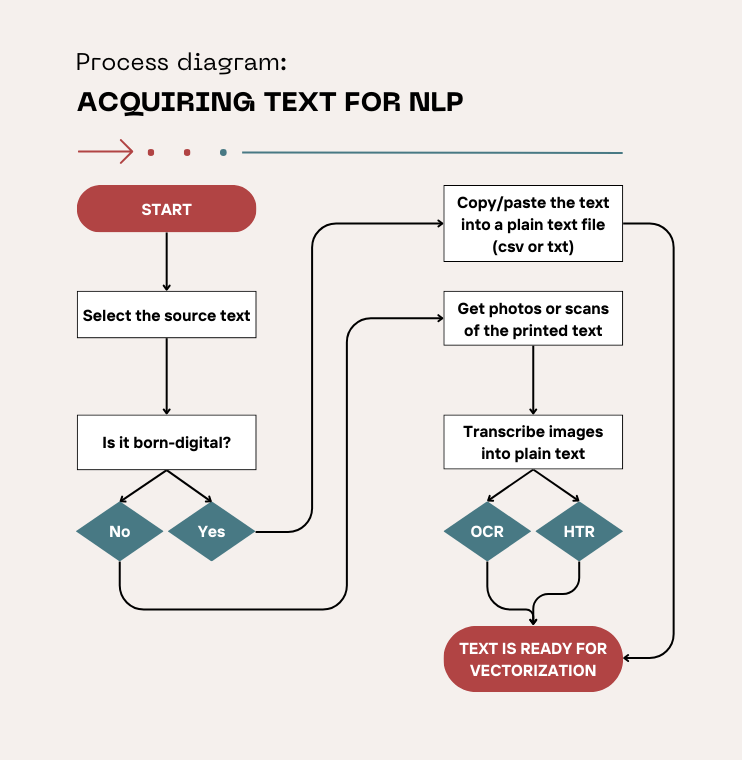
(Flowchart created in Canva.)
Once the text is available, ideally as a simple TXT or CSV file, the next step is to transform the text into something a machine can understand, because words and letters are meaningless to a computer that only really understands numbers. Transforming the text in this way is referred to as text vectorization; it transforms the text into numerical representations so that it can be analyzed by machine learning models or algorithms. The result turns the text into a dataset that is now ready to work with.
One common method is to represent each word as a unique number or a set of coordinates in a "vector space." Another is the "Bag of Words" approach, where the frequency of words is used to build a dataset. More advanced approaches like word embeddings can capture semantic relationships between words by placing them in a vector space where similar words are closer together.
However, before jumping into the analysis, it’s important to clean the data. Data cleaning in NLP involves removing irrelevant or potentially confusing information that could skew the results. The ultimate goal of data cleaning and text vectorization is to prepare the text for computational analysis, of which there are many methods and algorithms.
In my case, for authorship attribution—determining who wrote a particular text—common techniques include analyzing word frequencies, punctuation patterns, or sentence structures. Stylometric techniques, like Kilgariff’s Chi-Squared method or John Burrows’ Delta method, are often used in such cases to measure stylistic similarities or differences between texts. Machine learning models might be trained to recognize patterns in the writing, enabling more sophisticated and nuanced analysis. However, the downside of machine learning models is that they are very data hungry and only function well when there is a vast amount of text to work from.
After preparing the text and choosing the appropriate algorithms, the final step is to actually run the analysis. This could involve training machine learning models, comparing different texts, or calculating statistical measures of word usage. The results could reveal hidden patterns, differences between authors, or even shifts in language over time. With this combination of linguistic processing, data cleaning, and computational analysis, NLP opens up a wide range of possibilities for understanding and interpreting texts in new ways.
Methodology
The process of authorship attribution began with selecting and acquiring the texts I planned to use. I started with identifying early versions of the Histoire de la Marquise-Marquis de Banneville. I gathered these from the rare book collections at the Bibliothèque nationale de France (BnF) where first and second editions are available as digital copies, and the 1723 edition of the Histoire is available in print form; I also collected texts from the three potential authors. Once acquired, the texts were digitized and preprocessed to form a dataset suitable for computational analysis. “Preprocessing” in this case means data cleaning.
This included removing special characters, punctuation, or non-standard letters like accented characters. In some cases, all letters might be converted to lowercase to ensure uniformity. When working with older texts that were digitized through OCR, this process also involved correcting transcription errors that could have been introduced during scanning. The goal was to make sure the text is as clean and uniform as possible.
Another key part of the data cleaning was deciding whether or not to remove stop words. Stop words are common words in any language like "the," "is," "and," or "of" that do not carry specific meaning on their own but are necessary for constructing sentences. In some NLP applications, like topic modeling, these stop words might be removed to focus on content-heavy words. In contrast, to some analysts the stop words might carry subtle but important clues about a writer's style and therefore may be left in the dataset.
The next step involved creating a dataset from these texts, using NLP techniques in Python. Python is a versatile and accessible programming language known for its efficient high-level data structures and straightforward approach to object-oriented programming. Designed to be easy to learn, it has become widely popular across various fields, from web development to data analysis. (Its creator, Guido van Rossum, named the language after the BBC comedy show Monty Python's Flying Circus, adding an element of humor to the language’s origins.) Python is also classified as FLOSS (Free/Libre and Open Source Software), meaning its source code is freely available for anyone to use, modify, and distribute.
This open-source philosophy has encouraged a vast community of developers to contribute additional tools and libraries, enhancing Python’s capabilities. Many libraries are made available on platforms like GitHub, enabling others to benefit from and expand on existing resources. In the context of Python coding, a GitHub library is a collection of reusable code, tools, and resources shared on GitHub, often organized as a repository. It typically includes Python modules, functions, and classes designed to perform specific tasks or add functionalities; everything from data analysis to machine learning). Developers can integrate these libraries into their projects by cloning or downloading the repository or installing it. Libraries on GitHub often come with documentation, examples, and licensing information to help users understand and use the code effectively.
The collaborative nature of Python has produced a variety of specialized tools, including Fast Stylometry, which is just one example of a library resource that can be used for handling complex analyses. I’ll be incorporating Fast Stylometry into my project in order to utilize John Burrow’s Delta method. It’s a commonly used statistical method for authorship attribution in which the algorithm calculates the "delta" or difference between the frequencies of common words (or other stylistic markers) in an unknown text and in samples of known authors’ works. By using standardized differences, Burrows's Delta highlights the distinctiveness of an author's style, helping to match a text to its most similar known author profile.
ACQUIRING TEXT
Using resources like WorldCat.org, I located editions of the Histoire and identified comparison texts from the same historical period. When selecting comparison texts for author attribution, I knew it was best to choose works that were similar in time period, genre, and style to the text in question. This ensured a fair basis for comparison, as patterns of language use, themes, and stylistic choices are more likely to align.
The goal was to find works with similar themes, subject matter, or time period to compare linguistic styles. These included Charles Perrault’s Mother Goose Tales, which are contemporaneous fairy tales, as well as the particular edition of Sleeping Beauty that was published in the Mercure galant in the same year as the Histoire’s second edition. I also selected Madame L'Héritier Oeuvres Meslées, particularly including Marmoisan, for its thematic similarity of cross-dressing, and the Memoirs of the Abbot de Choisy Dressed as a Woman by the abbé de Choisy, given its relevance to gender fluidity, as well as a volume of his Memoires Pour Servir A L'Histoire de Louis XIV because its description of the royal court reflects experiences had by the Histoire’s main character.
(Flowchart created in Canva.)